

Which BMW Has the Best Gas Mileage? 2026 Models Ranked for Bay Area Drivers
BMW has a reputation for performance first, efficiency second. That reputation isn't wrong, but it's incomplete. If you're looking for the BMW with the best gas mileage, the data may surprise you: several 2026 BMW models post fuel economy numbers that rival mainstream family sedans like the Toyota Camry and Honda Accord.
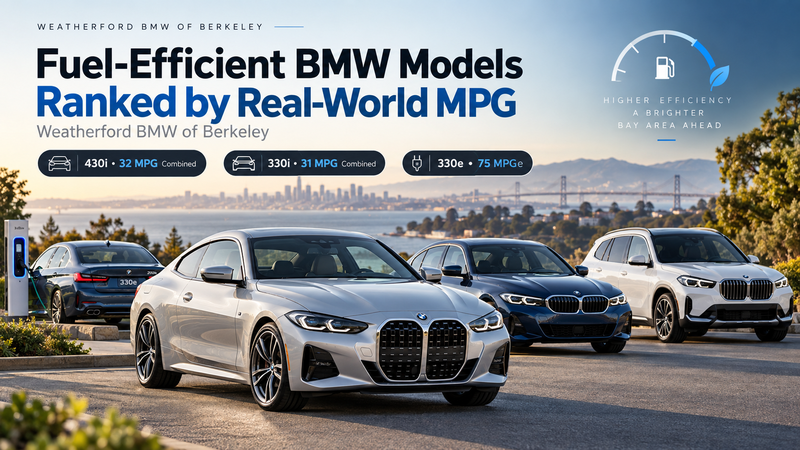
If you've been assuming the BMW badge automatically means a big gas bill, the EPA numbers tell a different story. The 2026 430i hits 32 mpg combined. The 330i follows at 31 mpg. Those aren't compromises; they're legitimately competitive numbers.
At Weatherford BMW of Berkeley, we see this tension play out constantly. Bay Area drivers face bumper-to-bumper I-80 traffic one morning and an open stretch of Highway 1 the next. The BMW that makes sense for a 12-mile East Bay commute isn't necessarily the right call for someone driving to Sacramento twice a week. Matching BMW fuel economy to your actual driving pattern is the real question, and it's one we help customers answer every day.
This article gives you EPA-rated numbers for gas-only and plug-in hybrid BMW models, real-world test data from Car and Driver, Consumer Reports, and Edmunds, a city-versus-highway recommendation breakdown, and specific guidance on which BMW to consider based on how you actually drive.
BMWs with the Best Gas Mileage, Gas-Only Models with the Highest Combined MPG
The efficiency hierarchy across BMW's gas-only lineup follows a clear pattern: smaller engine, rear-wheel drive, better fuel economy. Once you understand that pattern, comparing models becomes straightforward.
The 430i leads all gas BMWs at 32 mpg combined
The 2026 BMW 430i earns the top spot among the most fuel-efficient BMW gas models with EPA ratings of 28 city, 36 highway, and 32 combined for the rear-wheel-drive coupe configuration, verify your specific trim against the EPA window sticker at FuelEconomy.gov, as figures can vary slightly by body style. That 36-mpg highway figure is the number to watch if highway miles dominate your driving.
The coupe body style and the B48 four-cylinder engine are the two factors that get the 430i to that number. Add xDrive all-wheel drive and you typically lose 1 to 2 mpg combined depending on configuration, dropping the combined figure to around 30 to 31 mpg. The M440i, which swaps in BMW's inline-six, lands at 30 mpg combined. That's roughly a 2-mpg penalty for a meaningful jump in power. If performance is secondary to efficiency, the 430i's base four-cylinder is the clear pick.
The 330i and X1: strong second-tier choices
The 2026 330i sedan delivers 28 city, 35 highway, and 31 combined in rear-wheel-drive form. That's nearly identical to the 430i on the combined figure, and Consumer Reports' real-world testing recorded 29 mpg overall for the 330i in mixed driving, tracking almost exactly with the EPA estimate. For most buyers, the 330i offers the best combination of practical sedan packaging and genuine fuel efficiency within the BMW lineup.
The X1 xDrive28i comes in at 25 city, 34 highway, and 28 combined. If you need SUV versatility and BMW gas mileage is still a priority, the X1 is the practical compromise. Step up to the X5 or X7 and efficiency drops into the low-to-mid 20s combined, which removes them from consideration for efficiency-focused buyers.
How engine and drivetrain choices shift the numbers
Two rules cover most of the BMW lineup. First, upgrading from a four-cylinder to an inline-six costs roughly 3 mpg combined. The 330i-to-M340i comparison is the clearest example: the M340i drops to about 26 mpg combined versus 31 for the 330i. Second, adding xDrive all-wheel drive typically costs 1 to 2 mpg on the same model. If fuel economy is your primary concern, rear-wheel drive and the base four-cylinder engine are the combination to choose.
Plug-in hybrids: what MPGe actually means day to day
BMW's plug-in hybrid numbers look impressive on paper. The 330e carries a 75 MPGe EPA rating. But that number only applies while the battery has charge. Understanding when it applies, and when it doesn't, determines whether a PHEV is the right choice for you.
The 330e: 75 MPGe and about 22 miles of electric range
The rear-wheel-drive 330e delivers 75 MPGe when the battery is charged and you're driving within its roughly 22-mile electric range. Once that battery depletes, the car operates as a conventional hybrid and returns approximately 28 to 30 mpg combined on gasoline alone, close to what a standard 330i delivers, based on EPA charge-sustaining figures and published third-party testing.
The math is simple: if your daily round-trip commute stays under 20 miles and you charge overnight, the 330e is among the most fuel-efficient BMW sedans you can buy. If you rarely plug in, you're driving a slightly heavier 330i with a smaller fuel economy advantage.
The 530e: longer electric reach for longer commutes
The 530e extends the electric range to roughly 36 to 38 miles, which covers a meaningful round-trip commute on electricity alone. Combined MPGe and gas-only fallback figures vary by configuration; confirm the exact numbers for your specific trim on FuelEconomy.gov or the EPA window sticker before purchasing.
For Bay Area drivers who need a larger, more comfortable sedan and can charge daily, the 530e is a compelling option. For those who regularly make uninterrupted highway runs without access to charging at the destination, the larger vehicle weight works against you.
The honest math once the battery runs out
Without regular charging, a 330e or 530e behaves like a heavier gasoline sedan. The headline MPGe figure disappears once the battery is depleted.
Bay Area drivers have a structural advantage here: mild temperatures mean the 15 to 30 percent cold-weather range loss common in northern U.S. climates is largely a non-issue. Even on cold East Bay mornings, a 330e owner should plan on 15 to 17 miles of usable electric range rather than the full 22.
For those with home charging or reliable workplace charging access, the PHEV case is solid. For those without, the 430i or 330i is the more predictable path to consistent fuel efficiency.
Real-world MPG vs. EPA ratings: what the test data shows
EPA BMW MPG numbers are useful baselines, but they're lab results. Published real-world tests from Car and Driver, Consumer Reports, and Edmunds tell the more honest story, and for BMWs, that story is mostly favorable.
Where BMWs outperform their EPA labels
Car and Driver's 75-mph highway loop recorded 41 mpg for the 330i against an EPA highway rating in the mid-30s, a gap of several mpg in the driver's favor, depending on which EPA figure you're comparing. The M3 Competition beat its EPA highway figure by 9 mpg in the same test format. This pattern reflects BMW's efficient highway cruising calibration. On a long road trip, a 3 Series mpg estimate from the sticker can understate what you'll actually see at steady speeds.
The M4 showed a similar result in Edmunds testing: 26.6 mpg real-world versus 19 mpg EPA combined. Even performance trims can exceed their EPA numbers under steady highway conditions, though aggressive driving pushes results well below the combined figure.
Why city and mixed driving tells a different story
Consumer Reports recorded 29 mpg for the 530i xDrive in mixed driving, essentially matching its EPA combined figure. City results track closer to EPA than highway tests do, partly because stop-and-go driving conditions are harder to optimize than steady cruising.
For a 330i in Bay Area stop-and-go traffic on I-80 or I-580, expect 18 to 25 mpg rather than the 28 city EPA figure. Repeated acceleration from near-zero is the efficiency killer. Even slow, flowing freeway traffic typically returns only 20 to 26 mpg for a 330i.
Consumer Reports' broader analysis found conventional gasoline cars averaged about 0.7 mpg below their EPA labels across a large vehicle sample. That's reassuring context: BMW's fuel economy ratings are generally honest baselines for planning purposes, not optimistic outliers.
Which BMW has the best gas mileage for city driving?
The best fuel-efficient BMW for a 12-mile East Bay commute is not the best choice for weekly runs to Lake Tahoe. Matching the model to your actual driving pattern matters more than chasing the highest combined MPG figure on a spec sheet.
Stop-and-go Bay Area commutes favor the PHEV models
Interstate 80, 580, and the Bay Bridge approach are textbook plug-in hybrid territory. Short, repeated trips at moderate speed favor electric-only operation, exactly what the 330e and 530e are designed to deliver. A 330e fully charged each night covers a typical East Bay round-trip commute mostly on electricity. Over a month of Bay Area driving, that difference versus a gas-only sedan adds up to a real number on your fuel receipts.
Bay Area temperatures work in PHEV owners' favor. Cold-weather battery range loss, a significant concern in northern climates, is minimal here. A 330e owner in Berkeley can count on more consistent electric range than the same driver would see in Chicago or Denver.
Open highway runs shift the calculus toward gas models
On runs to Sacramento, Tahoe, or down to Los Angeles, a 430i or 330i will often exceed its EPA combined figure. The PHEV advantage disappears without charging infrastructure at the destination. For regular highway-heavy drivers, the 430i's 32 mpg combined and 36 mpg highway rating is a simpler, more consistent answer than a plug-in hybrid that reverts to gas-only operation for most of the trip.
One practical note for Bay Area drivers: steady 55 to 65 mph cruising typically outperforms both congested stop-and-go traffic and fast 75 to 80 mph highway runs. Aerodynamic drag rises sharply above 65 mph, which is why the sweet spot for real-world BMW fuel economy on open roads sits in that moderate speed range.
Finding your match at Weatherford BMW of Berkeley
Spec sheets and EPA labels are starting points. The most direct way to understand which BMW fuel economy profile fits your daily life is to drive the candidates back to back on roads you actually use.
New inventory aligned with the top efficiency picks
Weatherford BMW of Berkeley stocks 2026 models including the 430i, 330i, X1, 330e, and 530e, though inventory changes regularly, so contact the dealership to confirm current availability. Comparing trims side by side in person gives you a clearer picture than any online tool can provide. Scheduling a back-to-back test drive of a 330i and a 330e on local East Bay roads is the most practical way to understand how each one performs in your actual commuting conditions.
Certified Pre-Owned options for efficiency-focused buyers on a budget
The CPO program covers pre-owned BMWs that meet strict inspection standards and includes warranty coverage. A 2020 to 2022 330i RWD or X1 sDrive28i from the CPO inventory delivers near-current fuel economy ratings at a meaningfully lower price point. These are the model years where BMW's B48 engine is well-proven and reliability data is strong. For buyers who want the efficiency of the top gas-only picks without new-car pricing, CPO is the practical path.
The dealership's finance team can also model the long-term cost comparison between a new PHEV and a CPO gas model, factoring in California fuel prices, likely charging costs, and available incentives. The PHEV price premium often looks different after that math.
Service habits that keep your BMW at peak fuel economy
The gap between a well-maintained BMW and a neglected one shows up in real-world fuel economy before it ever triggers a warning light. A few key maintenance items account for most of that difference.
The three items with the biggest MPG impact
Tire inflation: BMW recommends checking cold pressure monthly. Underinflated tires are the single most common and most overlooked cause of below-EPA fuel economy. According to EPA guidance, each 1 PSI drop across all four tires can reduce fuel efficiency by a measurable amount, follow BMW's recommended tire pressure specs to stay at the top of your range. Bay Area temperature swings between cold hill mornings and warm afternoons make this worth monitoring regularly.
Engine air filter: A clogged filter forces the engine to work harder. Stop-and-go Bay Area driving and coastal air can accelerate filter buildup faster than BMW's standard service interval assumes.
Engine oil: BMW-approved low-viscosity oil (LL-01 spec) reduces internal friction compared to non-spec alternatives. Industry testing indicates that using the correct viscosity grade can recover a small but measurable percentage of fuel efficiency, and over years of driving, that compounds. It's a straightforward win for a routine service item.
When to bring it in and what to ask for
BMW's Condition Based Service system tracks oil life, brake wear, and filter status through the dashboard. Waiting for the indicator works for most drivers, but efficiency-focused owners benefit from an annual check at Weatherford BMW of Berkeley's service department to catch issues before they compound.
Certified BMW technicians can also confirm that engine management software is current, since BMW releases efficiency calibration updates that don't always trigger a dashboard notification. Reach out to our service team to schedule an appointment or discuss what to prioritize at your next visit.
The bottom line: which BMW has the best gas mileage for your drive?
The ranking is clear. Among gas-only models, the 430i leads at 32 mpg combined, the 330i follows at 31 mpg, and the X1 xDrive28i offers the best efficiency among BMW's SUV lineup at 28 mpg combined. For Bay Area city commuters who charge regularly, the 330e and 530e PHEVs win outright, the 330e earns 75 MPGe with approximately 22 miles of electric range per charge, making it the BMW with the best gas mileage for short urban commutes when plugged in consistently.
The right answer depends on your driving pattern. A 15-mile daily Oakland commute with overnight charging is a different equation than 200-mile round trips to Lake Tahoe. Neither the spec sheet alone nor a single combined MPG figure tells the whole story.
Weatherford BMW of Berkeley can build a side-by-side fuel economy comparison based on your actual commute distance and route. We can show you current new and certified pre-owned inventory from the models ranked above and appraise your current vehicle while you test drive. Contact the dealership directly to set that up, it's the fastest way to find the BMW that actually fits how you drive.